DejaViewed — Turning My Instagram Saved Tab Into an AI-Powered Knowledge Graph
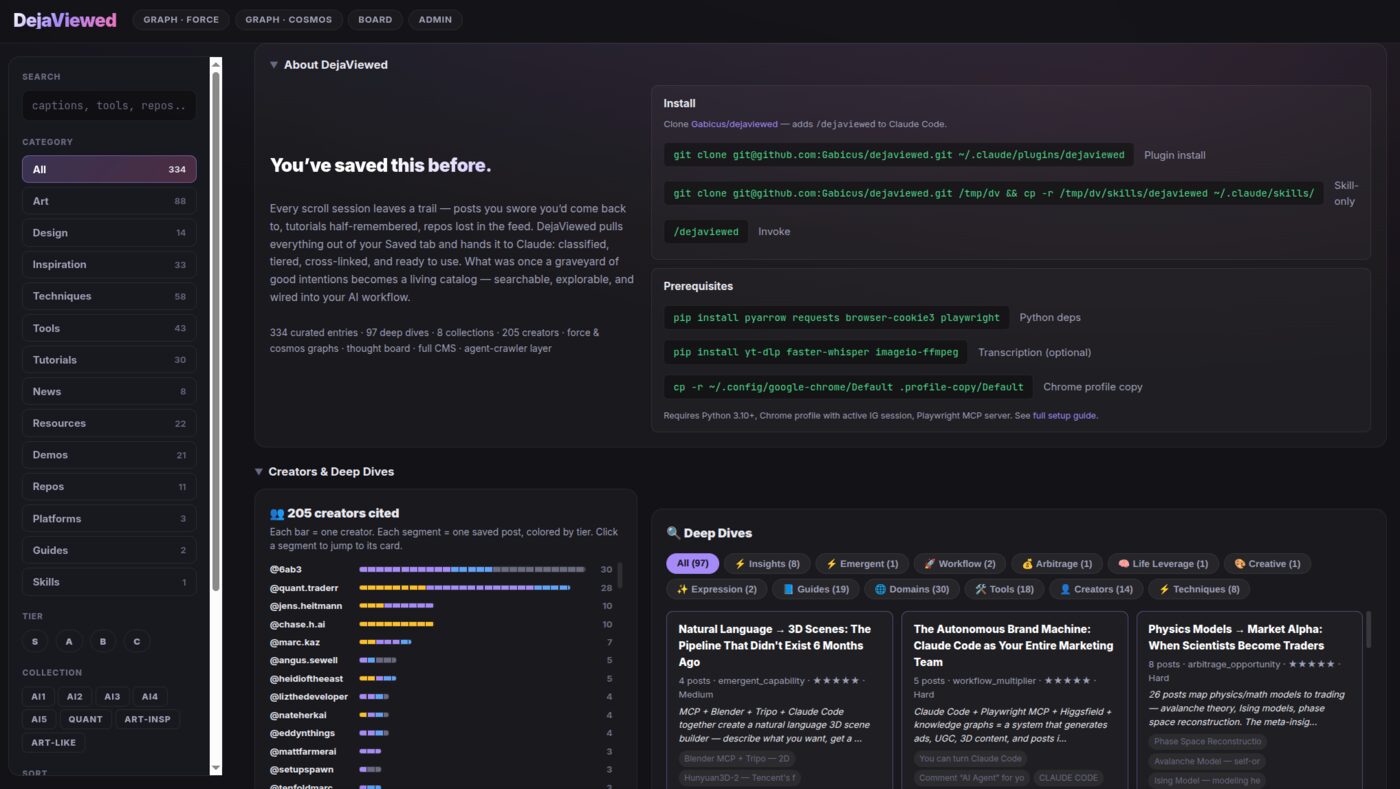
Every scroll session leaves a trail — posts you save and come back to, or don’t. I had 334 of them sitting in my Instagram saved tab spanning AI research, generative art, quantitative finance, physics simulations, and creative coding. DejaViewed turns that mess into something useful.
The Catalog
At its core, DejaViewed is a curated catalog. Every saved post gets classified: collection, tier (S through C), creator, tools used, techniques demonstrated, and domains covered. The home page lets you filter, search, and browse entries with full metadata.
Graph · Force
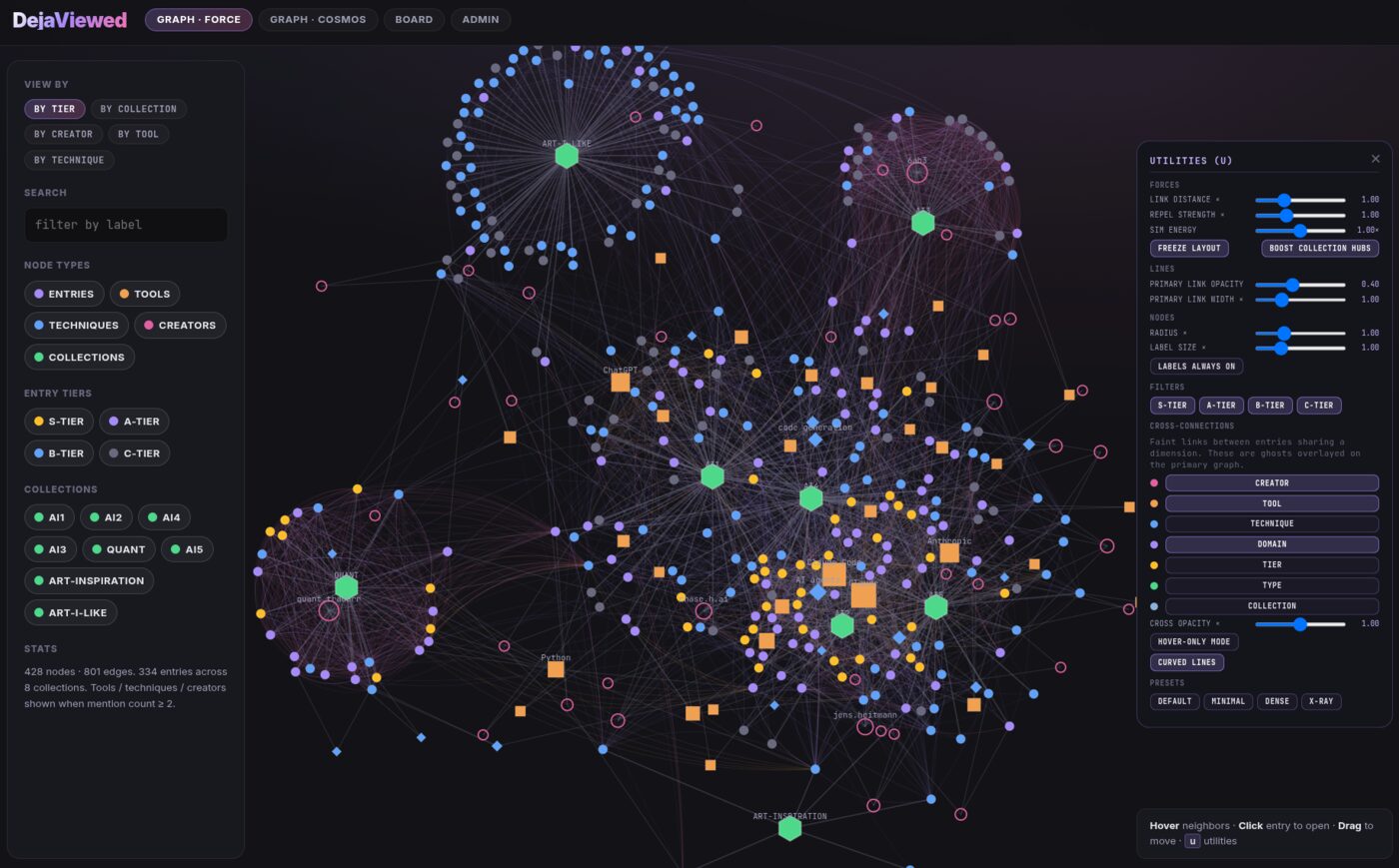
The force-directed graph maps every entry as a node connected to its tools, techniques, creators, and collections. You can filter by node type, toggle taxonomies (by tier, collection, creator, tool, technique), and overlay cross-connections — faint ghost lines between entries that share a dimension. It’s built on D3.js with a full utilities panel for tweaking forces, link opacity, node sizes, and presets.
The graph repo is open source: Gabicus/graph-node
Graph · Cosmos
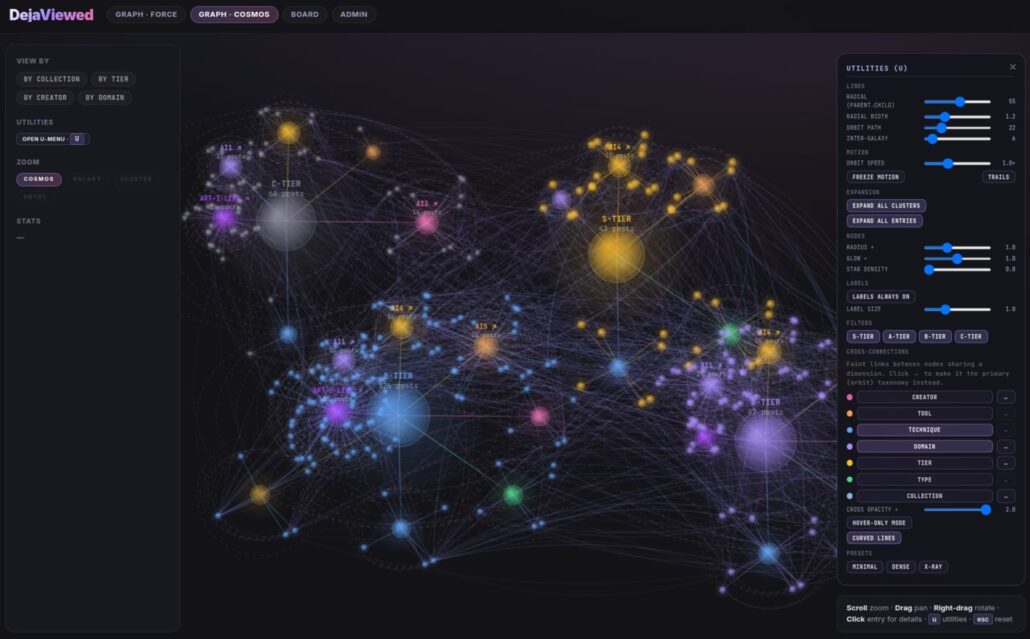
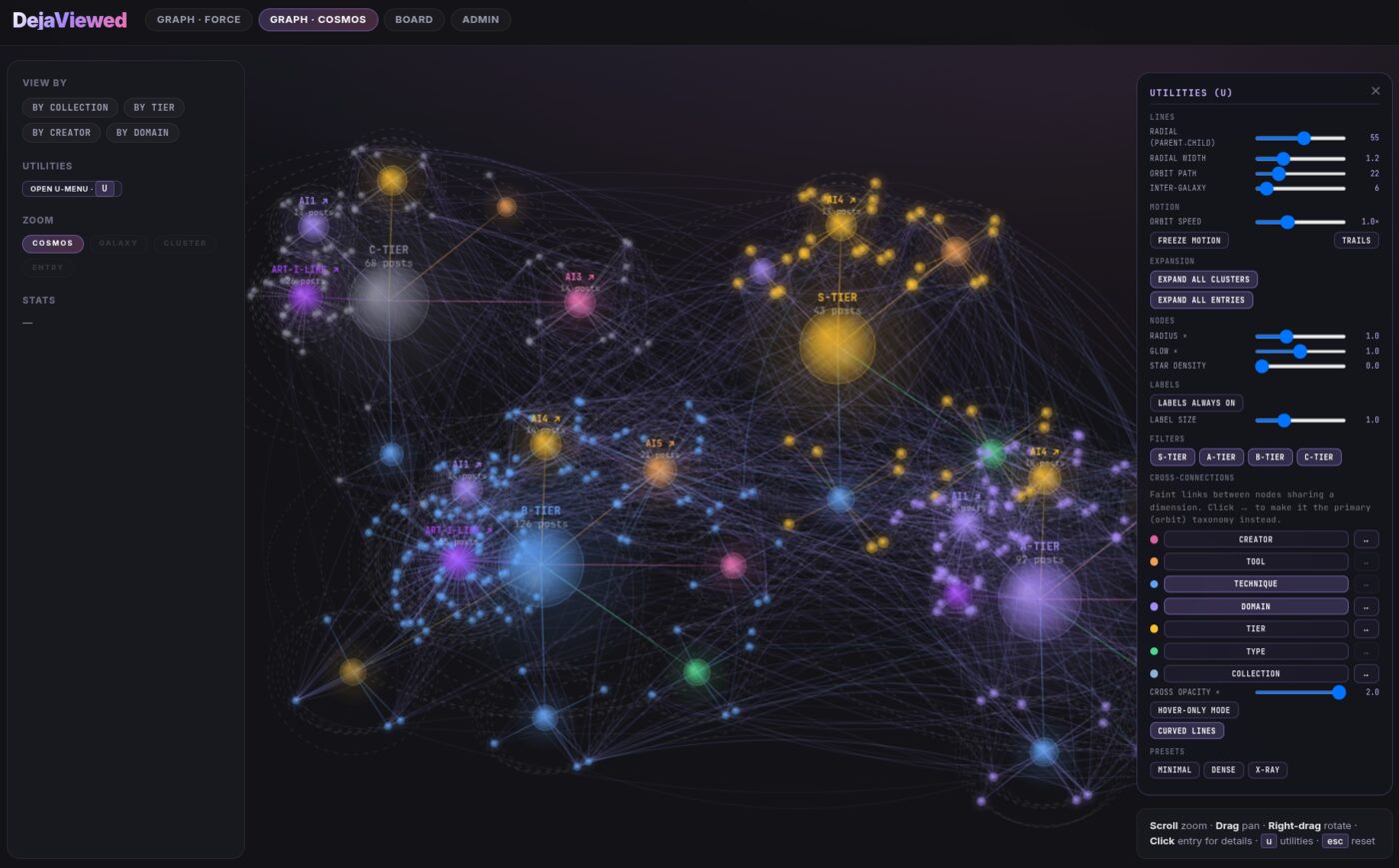
Cosmos takes a completely different approach — an orbital visualization where collections become galaxies, tiers become clusters, and entries orbit their parents like solar systems. It’s rendered on Canvas with real physics: springs, damping, orbital mechanics. You can drag nodes, fly-to zoom, toggle cross-connections across dimensions, and switch the primary taxonomy driving the orbital layout. The X-ray preset expands everything and freezes motion so you can trace every connection.
Also open source: Gabicus/graph-cosmos
Deep Dives — Where AI Connects the Dots
This is where it gets interesting. DejaViewed doesn’t just organize content — it synthesizes it. The deep dive pages are AI-generated analyses that pull threads between entries you’d never connect on your own.
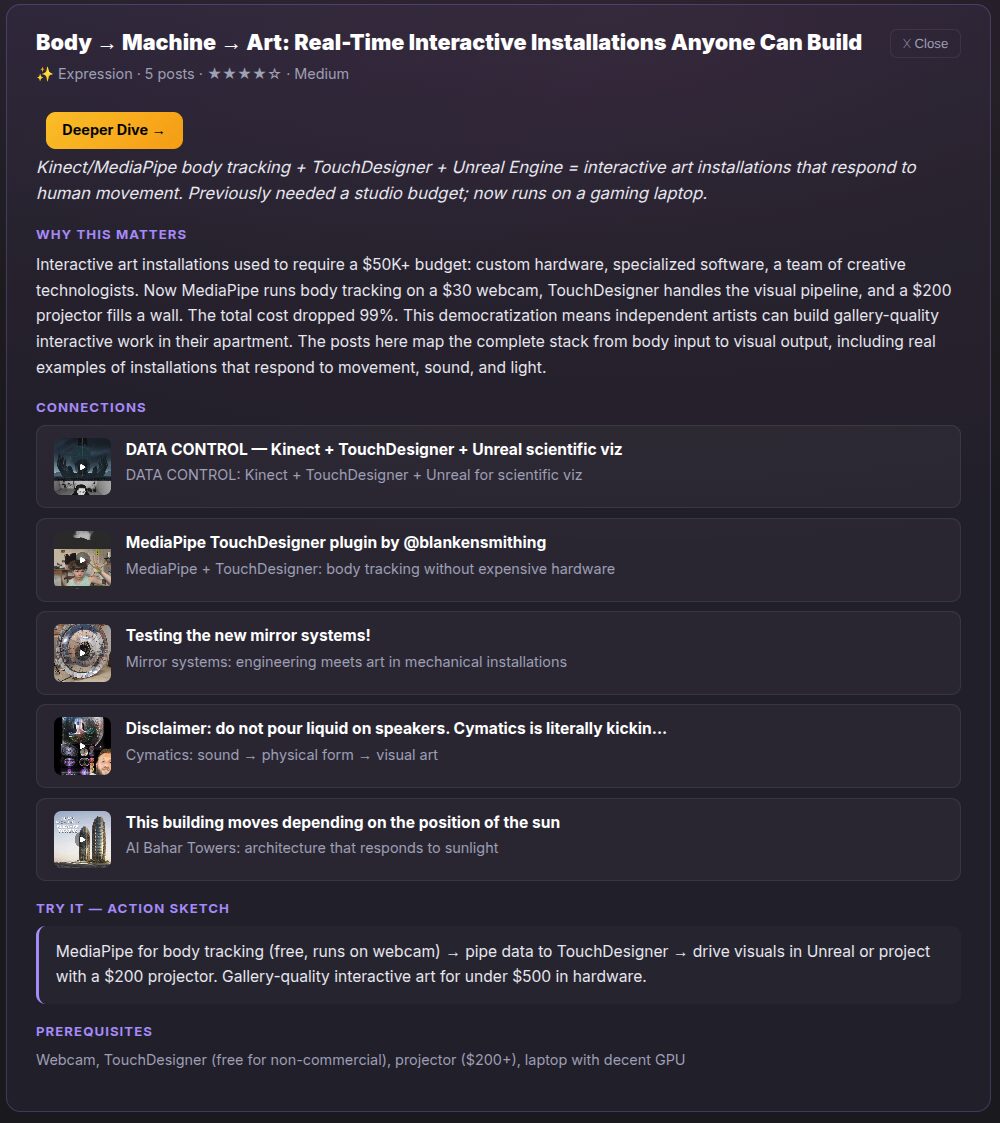
Take “Body → Machine → Art: Real-Time Interactive Installations Anyone Can Build” — it connects five completely separate saved posts into a coherent narrative about how body tracking (Kinect, MediaPipe), creative coding (TouchDesigner), and real-time rendering (Unreal Engine) have democratized interactive art. What used to require a studio budget now runs on a gaming laptop for under $500. It links NASA/CERN data visualization, hand-tracking plugins, mirror systems, cymatics, and parametric architecture into one story about accessible creative technology.
That’s what makes AI such an invaluable resource for knowledge work — not just answering questions, but finding the connections between things. A human saves 334 posts over months. An AI reads all of them at once and says “these five posts from different creators, different months, different domains — they’re actually about the same revolution.” The deep dives are the next level: moving from organization to genuine insight.
The /dejaviewed Skill
The whole pipeline — from Instagram scrape to classified catalog to generated deep dives — is driven by a Claude Code skill called /dejaviewed. It handles data extraction, classification via DuckDB + Parquet, thumbnail generation, guide page creation, and catalog builds. The site deploys automatically to dejaviewed.dev via Cloudflare Pages on every push to main.
Explore It
- Live site: dejaviewed.dev
- Force graph repo: Gabicus/graph-node
- Cosmos graph repo: Gabicus/graph-cosmos
- Deep dive example: Interactive Installations Deep Dive

Leave a Reply
Want to join the discussion?Feel free to contribute!